Best Practices in Results-Based Management for African Governments: A Practical Guide
What Is Results-Based Management and Why It Matters for African Governments
Results-Based Management (RBM) is a management approach that shifts the focus from what a government does — activities, spending, processes — to what it actually achieves for citizens. At its core, RBM asks a deceptively simple question: are our interventions producing the outcomes we intended?
For African public institutions, this question carries real weight. Budget constraints, growing service delivery demands, and accountability pressures from both citizens and development partners make it critical that every policy decision and programme investment can be tracked back to a measurable result. RBM provides the architecture for doing exactly that.
The concept sits within the broader framework of Managing for Development Results (MfDR) — a governance approach championed across the continent by institutions such as the African Development Bank (AfDB) and regional economic communities. MfDR treats results not as a reporting formality but as the organising logic of public administration itself.
Critically, RBM is not a donor compliance tool. Governments that adopt it primarily to satisfy external reporting requirements tend to build hollow systems that collapse once project funding ends. The real value lies in using results data to improve internal decision-making, allocate resources more effectively, and build the kind of domestic accountability that sustains development gains over time.
Aligning RBM with National Development Plans and Continental Frameworks
RBM works best when it is anchored to existing national and regional planning instruments, not grafted on as a parallel system. Every African government operates within a web of planning commitments — National Development Plans (NDPs), sector strategies, and continental frameworks such as the African Union's Agenda 2063 and the UN Sustainable Development Goals (SDGs).
The connection between these frameworks and day-to-day RBM practice is not always obvious, but it matters enormously. A ministry's results framework should trace a clear line from its programme outputs up through national NDP priorities and, where relevant, to Agenda 2063 aspirations. Without that vertical alignment, ministries risk pursuing results that are technically measurable but strategically disconnected from what the country has committed to achieve.
Practical alignment means reviewing NDP targets when defining programme outcomes, mapping SDG indicators to existing data collection systems, and ensuring budget programme structures reflect the same results logic used in planning documents. This is harder than it sounds — in many countries, planning, budgeting, and M&E functions sit in different institutions with different timelines. Bridging those silos is itself a governance reform priority.
The AfDB's Managing for Development Results framework offers a useful reference point for governments seeking to harmonise their RBM efforts with continental expectations while retaining country ownership of the process.
Building a Robust Results Framework: From Inputs to Impact
A results framework — sometimes called a logframe or results chain — maps the causal logic connecting a programme's resources to its intended long-term impact. Getting this structure right is the foundation of functional RBM.
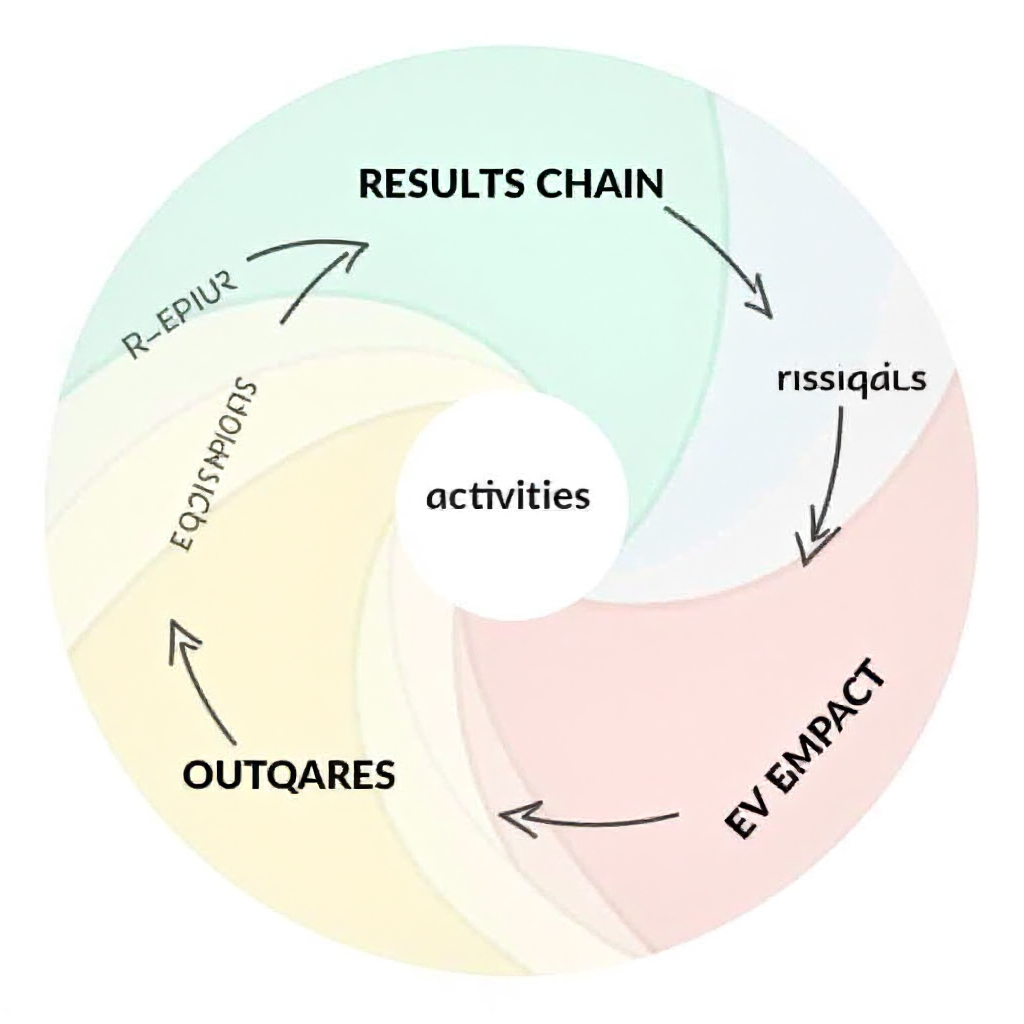
The standard results chain moves through five levels:
- Inputs: financial, human, and technical resources committed to the programme
- Activities: the specific actions carried out using those resources
- Outputs: the direct, tangible products of those activities (training sessions delivered, kilometres of road constructed)
- Outcomes: the behavioural or systemic changes that result from outputs (improved tax compliance, reduced travel time to markets)
- Impact: the long-term development change to which the programme contributes (reduced poverty, improved food security)
For resource-constrained settings, the most common mistake is designing results chains that are technically correct but practically unmeasurable. A ministry with limited statistical capacity cannot realistically track 15 outcome indicators across a five-year programme. A more workable approach is to identify two or three high-priority outcomes, build measurement systems around those, and expand incrementally as capacity improves.
The Theory of Change underpinning the results framework also needs explicit articulation. This means stating the assumptions that must hold true for outputs to produce outcomes — assumptions about stakeholder behaviour, institutional conditions, or external factors. Surfacing those assumptions early makes the framework more honest and helps teams anticipate where implementation might break down.
Selecting and Managing Performance Indicators
Good performance indicators are the difference between a results framework that guides decisions and one that generates paperwork. The selection process deserves more attention than most programmes give it.
The familiar SMART criteria — Specific, Measurable, Achievable, Relevant, Time-bound — are a starting point, but they do not capture everything that matters in the African public-sector context. Political feasibility is equally important. An indicator that accurately measures an outcome but touches a sensitive distributional question (who benefits, in which region) may be systematically under-reported. Choose indicators that programme managers and their supervisors will have an incentive to measure honestly.
The distinction between process indicators and outcome indicators is worth keeping clear:
- Process indicators track whether activities are happening as planned (number of workshops held, budget disbursement rate). They are easy to measure but tell you nothing about whether the activities are working.
- Outcome indicators measure whether the intended change is occurring (percentage of farmers adopting improved seed varieties, change in maternal mortality rate). They are harder to measure but far more informative.
Many programmes default to process indicators because outcome data is harder to collect. This is understandable, but it creates a reporting culture that confuses activity completion with development results — one of the more persistent traps in public-sector management.
A practical rule: for every process indicator in your framework, ask yourself what outcome it is supposed to contribute to, and then find at least one indicator that measures that outcome directly, even if measurement is less frequent.
Embedding Monitoring and Evaluation into the RBM Cycle
Monitoring and Evaluation (M&E) is the feedback engine of RBM — without it, the results framework is a planning document rather than a management tool. The goal is not just to collect data, but to use it to adjust implementation in real time and improve future programme design.
Functional M&E within an RBM system typically operates on two timescales. Routine monitoring — monthly or quarterly data collection against output and outcome indicators — should feed directly into management review meetings where programme officers can flag problems and make operational adjustments. Periodic evaluations, conducted at mid-term or programme end, ask deeper questions about effectiveness, efficiency, and unintended consequences.
The learning loop is where most systems break down. Data gets collected, reports get written, and then findings sit in drawers. For M&E to actually improve programmes, three conditions need to hold: findings must reach decision-makers in a usable format, decision-makers must have the authority to act on them, and budget and planning cycles must be structured to accommodate mid-course corrections. Aligning M&E review schedules with the annual budget calendar is a simple structural fix that significantly improves uptake of findings.
Common Implementation Challenges and How to Address Them
RBM implementation in African government contexts runs into predictable obstacles. Acknowledging them honestly — rather than pretending they can be engineered away — is the first step toward managing them.
Weak data systems are the most widespread constraint. Many ministries lack reliable administrative data, and national statistical systems are often under-resourced. The practical response is to start with what exists: administrative records, service delivery registers, and routine reporting systems can yield useful data if standardised and consistently maintained. Building data quality into existing systems is more sustainable than creating parallel data collection mechanisms for a single programme.
Staff turnover erodes institutional memory and disrupts continuity in results tracking. When the M&E officer who built the results framework moves to a better-paid donor position, the system often moves with them. Mitigation requires institutionalising RBM in standard operating procedures, not just in individual expertise. Documented frameworks, training cascades, and formal handover protocols reduce dependence on single individuals.
Political resistance to transparent results reporting is real. Measuring outcomes creates accountability, and not everyone in a system benefits from greater accountability. Leadership buy-in at the senior level — permanent secretary, minister — is not optional. Without it, RBM becomes a technical exercise that produces reports without influencing decisions.
Donor-driven fragmentation is a particular challenge when multiple development partners impose their own results frameworks, indicators, and reporting formats on the same ministry. The cumulative reporting burden can crowd out the actual management work RBM is supposed to support. Governments can push back by insisting on harmonised reporting through country systems — a principle embedded in the Paris Declaration on Aid Effectiveness and reaffirmed in subsequent international aid agreements.
Building Institutional Capacity for Sustainable RBM
Technical tools alone do not produce sustainable RBM. The institutions using those tools need to develop the human, organisational, and systems-level capacity building that allows results-oriented management to outlast any single project or funding cycle.
At the individual level, this means training programme officers, M&E specialists, and budget analysts not just in logframe construction or indicator design, but in how to use results data for decision-making. The ability to interpret data, communicate findings to non-technical audiences, and push back on poorly designed indicators is at least as important as technical data skills.
At the organisational level, RBM needs to be reflected in institutional incentive structures. If performance appraisals reward activity completion rather than outcome achievement, the management culture will follow. Some African governments have made progress embedding results orientation into public service reform frameworks, but the alignment between formal appraisal systems and RBM principles remains incomplete in most contexts.
Communities of practice have proven valuable for sustaining RBM momentum across government. Peer learning networks — whether within a single country across ministries, or regionally across similar institutions — allow practitioners to share what is working, troubleshoot common problems, and build a professional identity around results-oriented management. The MfDR community of practice in Africa, supported by institutions including the AfDB, provides one such platform for this kind of shared learning.
Sustainable RBM is ultimately a governance culture shift as much as a technical reform. The ministries that sustain it longest are those where results thinking is embedded in how staff talk about their work, not just in the frameworks they submit to donors.
Frequently Asked Questions
What is the difference between RBM and traditional activity-based management?
Traditional activity-based management focuses on whether planned activities were completed and funds were spent correctly. RBM shifts the emphasis to whether those activities produced the intended outcomes and, ultimately, the intended development impact. The difference is between asking "did we do what we said we would do?" and "did it work?"
How do African governments typically fund RBM capacity-building initiatives?
Funding comes from a mix of sources: national budget allocations within planning or finance ministries, technical assistance grants from development partners such as the AfDB or UNDP, and regional programmes that pool resources across countries. Governments with stronger ownership tend to seek domestic budget lines for M&E functions rather than relying entirely on project-based donor funding.
What role do development partners play in supporting or undermining RBM adoption?
Development partners can support RBM by aligning their own reporting requirements with country systems, funding long-term capacity building rather than short-term technical assistance, and recognising country-defined results frameworks as legitimate. They undermine it when they impose parallel reporting requirements, create dedicated project M&E units that bypass government systems, or shift priorities before institutional capacity has taken root.
How long does it realistically take to see results from an RBM rollout?
Basic systems — a functional results framework, routine data collection, and regular review meetings — can be operational within 12 to 18 months in a reasonably well-resourced ministry. Genuine culture change, where results data consistently influences budget and planning decisions, typically takes five to ten years and requires sustained leadership commitment across political cycles.
What are the most important first steps for a ministry just starting with RBM?
Start with a diagnostic: map existing planning, budgeting, and reporting processes to understand where results logic is already present and where the gaps are. Then focus on one or two priority programmes rather than attempting a ministry-wide rollout. Build a simple, realistic results framework for those programmes, establish baseline data, and create a review rhythm that connects findings to decisions. Small wins build the credibility and confidence needed to scale.