How to Build a Community of Practice for Development Professionals: A Practical Guide
Most capacity-building efforts in the development sector follow the same arc: a three-day workshop, a thick training manual, and then silence. Participants return to their offices, the binders collect dust, and six months later, nothing has changed. A community of practice (CoP) is built on a different premise entirely — that sustained peer learning, not episodic training, is what actually shifts how professionals work.
This guide walks through how to build one that lasts, specifically for development and governance professionals operating in public-sector environments across Africa and beyond.
What Is a Community of Practice — and Why It Matters for Development Work
A community of practice is a group of professionals who share a domain of concern, learn from each other through regular interaction, and collectively develop their practice over time. Unlike a workshop or a training program, it has no fixed end date and no single expert at the front of the room.
The concept, developed by Etienne Wenger and Jean Lave in the early 1990s, has found particularly fertile ground in knowledge-intensive fields where context matters enormously — and development work fits that description precisely. A public financial management officer in Nairobi and a results-based management advisor in Dakar face structurally similar challenges, but the solutions that work in one setting often need significant adaptation in the other. A CoP creates the space for that kind of contextual, peer-driven problem-solving.
What distinguishes a CoP from a professional association is the emphasis on active knowledge exchange rather than membership and credentials. What distinguishes it from a training program is that learning flows horizontally, between practitioners, not vertically from trainer to trainee. For governance practitioners working within the Managing for Development Results (MfDR) framework, this distinction matters: a CoP doesn't just teach RBM principles — it helps members figure out how to apply them when the budget cycle is disrupted or the political context shifts.
Identify Your Core Group and Define a Shared Domain
The most important decision you'll make is choosing a focused domain — a specific enough thematic area that members feel genuine professional stakes in it, but broad enough to sustain conversation over years.
Resist the temptation to build a CoP around a broad label like "development" or "governance." These are too diffuse to generate the kind of focused exchange that makes peer learning valuable. Instead, anchor the community around a practice area: results-based management, public financial management, monitoring and evaluation in fragile states, or subnational planning under decentralization. The more precisely you can name what members do in their daily work, the more useful the CoP becomes.
Start with a core group of 8 to 15 practitioners who already care about the domain. These are not necessarily the most senior people — they're the ones who will show up to an early-morning call, share a half-finished framework for feedback, and recruit a colleague when membership stalls. In the African public-sector context, this often means looking across ministries, regional bodies like the African Union, and donor-funded programs simultaneously, because the practitioners you need may sit in very different institutional homes.
Hold one or two informal conversations before any formal launch. Ask potential members what professional question keeps them up at night. If the same themes surface repeatedly, you've found your domain.
Design the Structure Without Over-Engineering It
A CoP needs just enough structure to function and no more. Over-engineered communities — with elaborate governance documents, multi-tiered committees, and quarterly reporting requirements — tend to collapse under their own administrative weight, especially in resource-constrained public-sector environments.
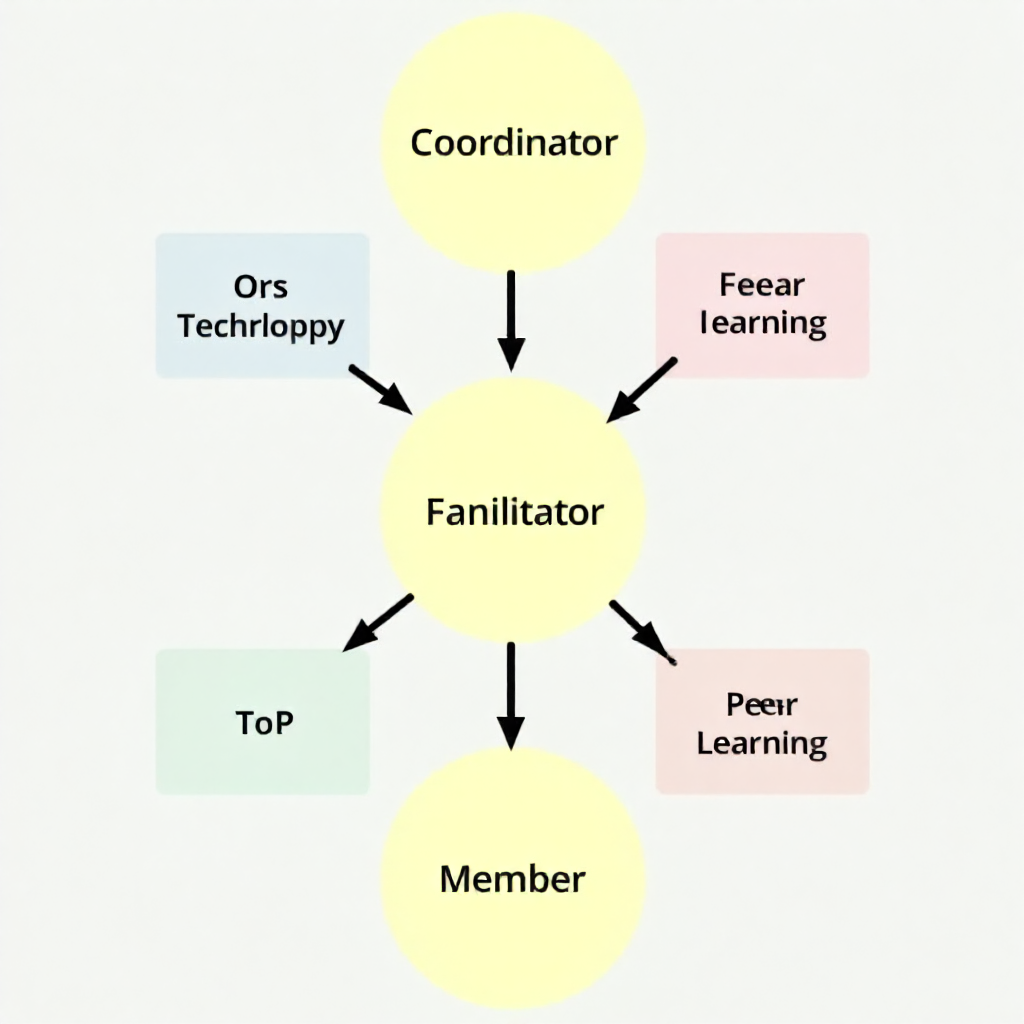
Three roles are sufficient to start:
- Coordinator: manages logistics, schedules sessions, maintains the member list, and keeps communication flowing between meetings.
- Facilitator: designs and leads the knowledge exchange sessions — this is the most critical role, discussed in detail below.
- Members: contribute their experience, raise real problems, and share what they're learning in their own practice.
For meeting cadence, monthly sessions work well for most development CoPs — frequent enough to maintain momentum, spaced enough that members can prepare something meaningful to bring. Keep sessions to 60-90 minutes. Longer than that and attendance drops, particularly when members are dialing in from government offices with competing demands.
On communication channels: WhatsApp groups work in many African contexts where email response rates are low. A shared Google Drive or a simple mailing list can handle document exchange. You don't need a dedicated platform. Choosing tools that members already use daily removes friction and signals that the CoP respects their time.
Facilitate Meaningful Knowledge Exchange
Facilitation is the single most important success factor in any community of practice. A skilled facilitator doesn't lecture — they create conditions for practitioners to learn from each other, surface tacit knowledge, and work through real problems together.
Three session formats tend to generate the most value in development and governance CoPs:
- Case discussions: A member presents a real implementation challenge — a results framework that isn't working, a stakeholder engagement process that stalled — and the group works through it together. The presenter leaves with concrete ideas; the group learns from a situation they didn't have to experience themselves.
- Practitioner spotlights: One member shares what they've learned from a recent project, including what failed. This works best when the facilitator asks probing questions rather than letting the session become a presentation.
- Problem-solving sessions: The group tackles a shared challenge — how to communicate RBM results to a minister who doesn't use the language of results-based management, for example — and collectively develops approaches members can test in their own contexts.
The facilitator's job before each session is to identify a topic with enough tension in it to generate real discussion. Safe topics produce polite conversation. Topics where practitioners genuinely disagree, or where standard guidance runs up against institutional reality, produce learning.
Sustain Engagement Over the Long Term
Most CoPs don't fail at launch — they fade somewhere between months six and eighteen, when the initial energy dissipates and attendance starts declining. Preventing this requires deliberate design, not just good intentions.
Rotate facilitation responsibilities after the first year. When the same person runs every session, the community becomes dependent on one individual's energy and availability. Rotating facilitation also develops capacity within the group and gives more members a stake in the CoP's success.
Refresh the domain periodically. The thematic focus that made sense in year one may need to evolve as the policy environment shifts or as members' own practice develops. Build in an annual conversation — even a 30-minute discussion at the end of a regular session — where members reflect on whether the CoP is still addressing what matters most to them.
Address turnover proactively. In African public-sector contexts, staff rotation, secondments, and the end of donor-funded program cycles can strip a CoP of key members within a short period. Build a light onboarding process so new members can get up to speed quickly, and keep a short archive of past sessions — summaries, not recordings — that captures institutional memory without requiring significant effort to maintain.
Measure Value Without Bureaucratizing the Process
Measuring CoP outcomes should take less time than the CoP itself. The goal is to demonstrate value — to members, to institutional sponsors, and to yourself — without turning the community into a reporting exercise.
Aligned with Managing for Development Results principles, focus on outcomes rather than outputs. The number of sessions held and the number of members enrolled are outputs. What matters is whether members are applying what they learn, whether the quality of their work is improving, and whether the CoP is contributing to better governance or development results in their institutions.
Three lightweight approaches work well:
- A brief quarterly check-in (three questions, five minutes) asking members what they've applied, what's changed in their practice, and what they'd like more of.
- An annual reflection session where the group collectively identifies concrete examples of how the CoP has influenced their work.
- Occasional stories of change — short narratives from individual members describing a specific situation where CoP learning made a difference.
These methods generate credible evidence of impact without requiring a monitoring and evaluation specialist to design them. They also give members a sense of the community's cumulative value, which itself sustains engagement.
Lessons from Building CoPs in African Public-Sector Contexts
The African development context is not a footnote to CoP design — it shapes nearly every practical decision. Building an effective community of practice in this environment means taking its specific constraints seriously from the start.
Connectivity is uneven and unpredictable. Video calls that work smoothly in one country may be prohibitively expensive or technically unreliable in another. Design sessions so that they work with audio only, and make written summaries available within 24 hours for members who couldn't join live. Asynchronous participation — contributing to a shared discussion thread between sessions — can be as valuable as live attendance.
Institutional hierarchies require careful navigation. In many government contexts, a junior officer will not openly challenge a senior colleague's approach, even in a learning setting. Skilled facilitation can create enough psychological safety for honest exchange — for example, by using anonymous question submissions or by explicitly framing sessions as peer learning rather than performance evaluation.
Multilingual environments add complexity. A CoP spanning Francophone and Anglophone Africa, or working across multiple national languages, needs a deliberate language policy — not necessarily translation of everything, but clear decisions about which sessions are in which language and how materials are made accessible across linguistic communities.
Finally, donor-funded program cycles pose a structural risk. When a CoP is embedded in a project with a fixed end date, it tends to dissolve when the project closes. The most durable communities of practice in the African public-sector context have found ways to anchor themselves in government institutions or regional bodies — like national planning commissions or regional economic communities — rather than in project structures alone. This is harder to arrange but dramatically improves longevity.
Frequently Asked Questions
How many members does a community of practice need to be effective?
Between 15 and 40 active members is the practical range for most development CoPs. Fewer than 15 and the community becomes fragile — one or two departures can destabilize it. More than 40 and sessions become too large for genuine peer exchange. A core group of highly engaged members matters more than total membership numbers.
What is the difference between a community of practice and a professional association?
A professional association is organized around membership, credentials, and advocacy. A community of practice is organized around shared practice and mutual learning. Associations tend to be formal and hierarchical; CoPs are informal and peer-driven. Many development professionals belong to both, but they serve different purposes.
How do you keep a CoP active when members have limited time?
Keep sessions short (60-90 minutes maximum), make participation flexible (not every member needs to attend every session), and ensure that each session delivers something members can use immediately. When people feel the CoP is worth their time, they find the time.
Can a community of practice be fully virtual in a low-bandwidth environment?
Yes, with deliberate design. Use audio-only options, keep video optional, distribute written materials in advance, and build asynchronous participation pathways. Some of the most active development CoPs in Africa operate primarily through structured email exchanges and periodic voice calls rather than video conferencing.
How do you get institutional buy-in for a CoP within a government agency?
Frame the CoP in terms of outcomes the institution already cares about — improved results reporting, better policy implementation, stronger technical capacity. Find one senior champion who understands the value of peer learning and can protect time for staff participation. Avoid framing it as an external initiative; wherever possible, position it as something the institution owns.