Integrating Gender Equality into Development Results Frameworks
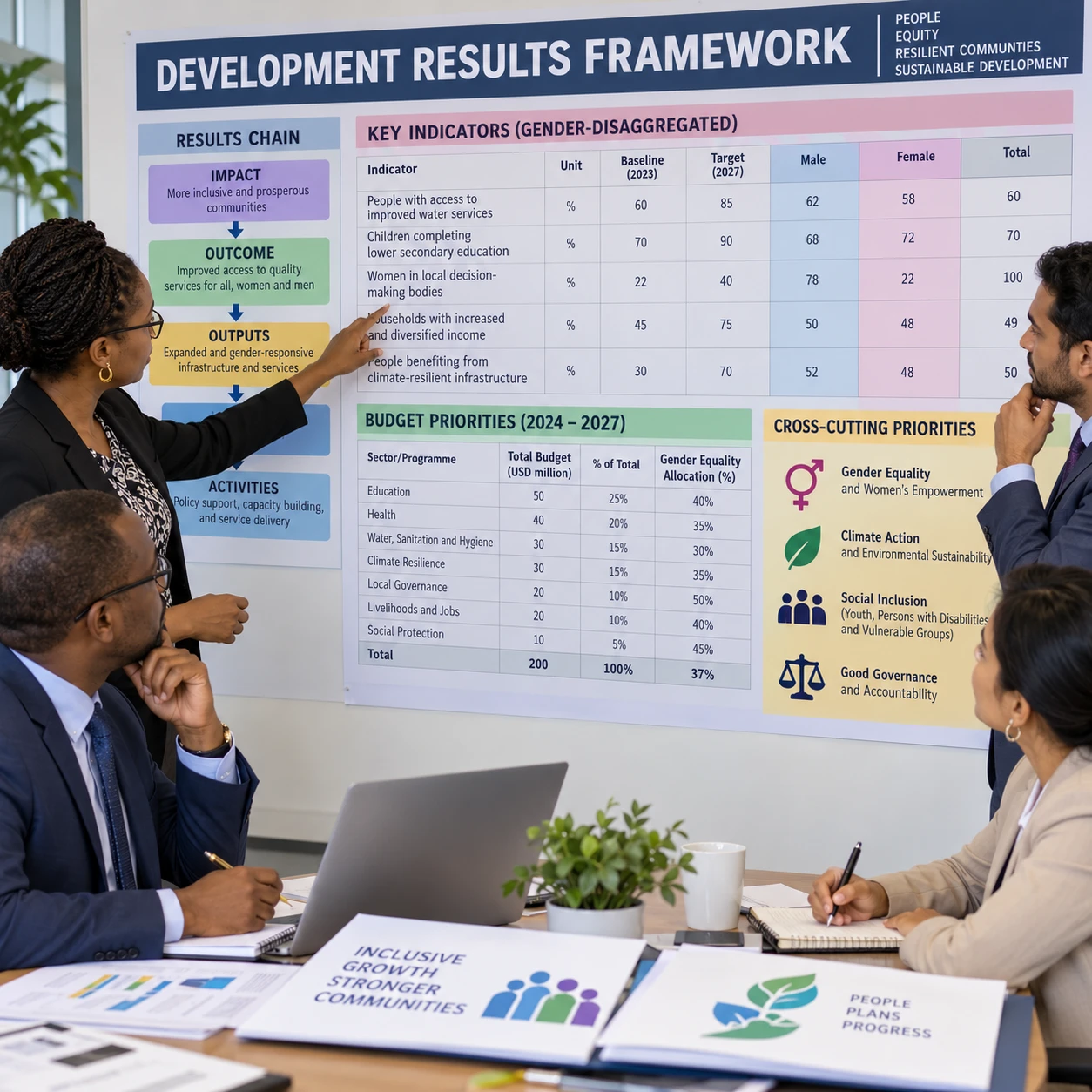
Public agencies use development results frameworks to connect policy priorities with services, outcomes, and accountability. Integrating gender equality into that framework helps decision-makers see who benefits, who may be left out, and what needs to change. The work is most effective when it shapes planning, budgeting, implementation, and monitoring from the start, rather than appearing as a separate activity or reporting requirement.
What a development results framework does
A development results framework links public priorities to activities, outputs, outcomes, and intended impacts, then assigns ways to measure progress and account for results. It gives managers a shared structure for planning and results-based management.
For example, a public employment program may fund training (an activity), deliver courses (an output), improve participants’ access to jobs (an outcome), and contribute to more inclusive economic participation (an intended impact). A useful framework makes these steps visible and clarifies the assumptions connecting them.
Gender equality belongs throughout this chain. If women, men, and people of different genders face different barriers to a service, the framework should show how the program will identify and address those differences. That means checking who can access the service, who completes it, and whether benefits and outcomes are equitable—not simply counting total participants.
A framework also supports accountability by naming indicators, data sources, reporting intervals, and responsible units. Its value depends on use: if indicators do not inform management decisions, the document can become a compliance exercise rather than a working tool for public sector planning.
Start with gender analysis and clear objectives
Start with gender analysis to identify who faces unequal access, influence, resources, or outcomes, then translate the findings into specific objectives. This gives gender equality commitments a clear connection to the problem a public program is designed to solve.
Gender analysis can draw on administrative records, consultations, service-user feedback, evaluations, and relevant research. Ask practical questions: Who uses the service? Who is missing? Do safety, cost, location, care responsibilities, documentation, or digital access affect participation differently? Are some groups represented in decision-making but not in the benefits?
Use the answers to set an objective that is relevant and measurable. A broad aim such as “promote inclusion” does not tell managers what to do or how to judge progress. A stronger objective might specify improved access to a defined service for an underserved group, with a baseline and a reasonable timeframe established from available evidence.
Be precise about the population and context. Gender disparities can intersect with age, disability, income, location, ethnicity, or migration status. Where it is safe and useful, analysis should recognize these differences without collecting sensitive information that agencies cannot protect or responsibly use.
Build gender equality into the results chain
Build gender equality into each stage of the results chain by linking activities and outputs to the changes needed for equitable outcomes. The framework should make clear how public action is expected to reduce a specific disparity.
Consider a municipal transport initiative intended to improve access to work and essential services. Activities might include safety audits and consultations at different times of day. Outputs could include redesigned routes, lighting improvements, or a complaint channel. Outcomes could track whether intended users report safer, more reliable access. The impact might be broader participation in employment or public life, although many factors beyond transport influence that result.
This distinction matters: agencies control activities and outputs more directly than long-term impacts. A framework should not claim that one project alone caused a broad social change. Instead, it can track the contribution the agency expects to make and state important assumptions, such as continued service funding or coordination with other institutions.
Check the chain for gaps. If an objective seeks better access but activities do not address the barriers identified in the gender analysis, the logic is weak. If outputs are counted without testing whether they improve access or quality, the framework may report delivery while missing the result that matters.
Choose indicators and data that reveal differences
Choose gender-sensitive indicators that measure relevant differences in access, participation, quality, or outcomes, and pair them with a baseline, target, data source, and reporting schedule. Disaggregated data helps show whether overall progress is shared fairly.
A gender-sensitive indicator measures a result in a way that can reveal gender-related differences. For a training program, total enrolment is useful, but it cannot show who completes the course or secures work afterward. Agencies might track enrolment, completion, and employment outcomes by sex, while using additional, locally appropriate categories where data can be collected safely and consistently.
Before selecting an indicator, confirm that the data exists or can be collected at a reasonable cost. Set a baseline so change can be assessed, and define what counts, who records it, and how often it will be reviewed. Administrative data may offer routine coverage; surveys and qualitative feedback can explain experiences that a count cannot.
Disaggregated data is not automatically complete or fair. Small sample sizes can expose individuals, categories may not reflect people’s identities, and inconsistent records can distort comparisons. Follow privacy rules, minimize sensitive data, explain its purpose, and suppress or combine small groups where disclosure is possible. Use qualitative evidence to interpret patterns rather than treating a single number as the whole story.
Align budgets, responsibilities, and reporting
Align gender equality commitments with funded activities, named owners, and routine reporting so the results framework can guide implementation. Gender-responsive budgeting helps test whether planned resources support the objectives and indicators.
For each result, identify the unit responsible for delivery and the unit responsible for data quality. A program manager may own service changes, while a monitoring and evaluation team checks indicator definitions and reporting. Assigning responsibility prevents gender equality from becoming an unfunded task that everyone supports in principle but no one manages.
Budget review should ask whether resources cover the measures required to achieve the result. Costs may include accessible outreach, consultation, staff training, safer service locations, data improvements, or evaluation. Gender-responsive budgeting does not require a separate budget line for every gender objective; it requires examining how revenue and spending choices affect different groups and whether resources match stated priorities.
Build reporting into existing management cycles where possible. Quarterly reviews, for example, can consider indicator trends alongside expenditure and delivery risks. When a target is off track, managers should record the cause, agree on a corrective action, and set a date to check whether it worked.
Address implementation and accountability challenges
Public agencies can strengthen implementation by addressing weak data, unclear ownership, and targets that measure activity rather than change. Regular review and clear accountability mechanisms help turn framework commitments into management decisions.
Common gaps include:
- Counting participation as equality: High attendance does not prove that a service is accessible or produces comparable benefits. Track completion, quality, and relevant outcomes as well.
- Setting indicators without baselines: A target has little meaning when current conditions are unknown. Establish a baseline first, or set a time-bound plan to collect one.
- Leaving responsibility vague: Shared ownership can become no ownership. Name a lead unit and specify what other teams must contribute.
- Collecting data without safeguards: More detail can improve analysis but also create privacy risks. Collect only what is necessary, protect records, and explain how information will be used.
At review meetings, ask three questions: What does the evidence show? Which groups are not benefiting as intended? What decision, resource, or delivery change follows? Documenting answers creates a practical accountability trail. Where data is incomplete, report the limitation honestly and assign an action to improve it rather than presenting uncertainty as success.
Frequently asked questions
These answers summarize how gender equality, indicators, data, and accountability fit within a development results framework.
What is a gender-sensitive indicator?
A gender-sensitive indicator measures a result in a way that shows relevant differences between groups, such as access to a service, completion rates, safety, or outcomes. It should have a clear definition and a feasible, responsible data source.
How can a results framework address gender equality?
Use gender analysis to define the problem, set a measurable objective, reflect the response across the results chain, and assign indicators, budgets, owners, and reporting routines. Review evidence and adjust implementation when results differ across groups.
Why is sex-disaggregated data important?
Sex-disaggregated data can reveal differences hidden by overall totals, helping agencies identify unequal access or outcomes. It should be interpreted alongside context and protected carefully; sex alone may not explain every gender-related disparity.
How can public agencies track gender-related outcomes?
Agencies can set a baseline, choose relevant indicators, disaggregate suitable administrative or survey data, and combine quantitative results with user feedback. Assign teams to review findings on a regular schedule and document follow-up actions.